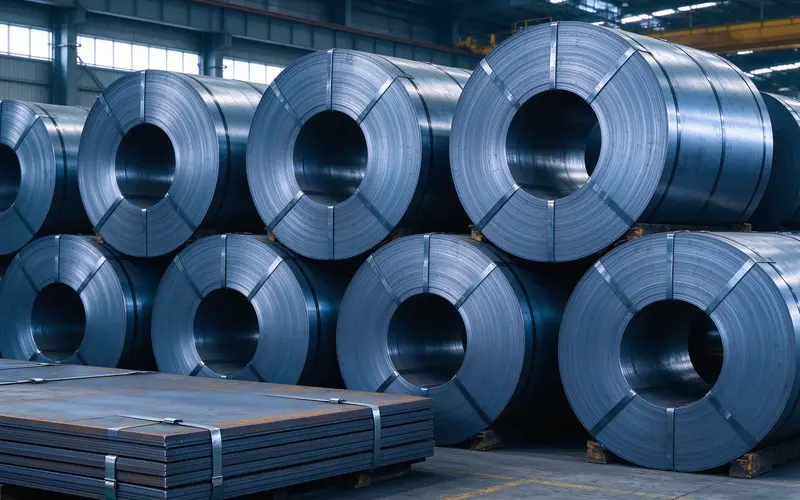
"Should I use hot-rolled or cold-rolled coil?" is one of the most common questions from buyers specifying steel. The choice affects cost, surface finish, tolerance, formability and downstream processing. Here is a practical comparison.
What Is the Difference?
Hot-rolled coil (HRC) is rolled at over 1000°C, right after continuous casting. It comes off the line with mill scale, a black oxide surface, in thicknesses from 1.5mm upward.
Cold-rolled coil (CRC) is made by further cold-reducing pickled HRC at room temperature, then annealing it. It has a smooth bright surface, tighter thickness tolerance, and comes in thinner gauges (0.3mm – 3.0mm).
Side-by-Side Comparison
| Property | Hot-Rolled (HRC) | Cold-Rolled (CRC) |
|---|---|---|
| Thickness range | 1.5 – 25.4mm | 0.3 – 3.0mm |
| Surface | Black mill scale, rough | Smooth, bright/matte |
| Thickness tolerance | ±5-8% | ±0.03-0.05mm |
| Flatness | Standard | Excellent, skin passed |
| Formability | Good structural bending | Excellent drawing/stamping |
| Relative price | Lower | 15-30% higher |
Choose HRC When:
- You need thickness above 3mm (beams, plates, structural parts)
- The surface will be painted, galvanized or hidden anyway
- You are making pipes, tubes, welded sections, or reinforcing
- Cost matters more than surface finish
Choose CRC When:
- You need thin gauge (0.5-2.0mm) with tight tolerance
- The part will be painted, powder-coated or visibly exposed
- You are stamping, drawing or deep-drawing appliance/auto panels
- Flatness and consistency matter for roll forming or laser cutting
Quick Rule of Thumb
If your part is structural, thick, or going to be painted/galvanized — use HRC. If it is thin, visible, or being stamped — use CRC. If you are between 2.0-3.0mm, you can often use either: HRC for cost savings, CRC for better surface and tolerance.
Unsure which grade or form fits your part? Send us your drawing and application, and we will recommend the most cost-effective material.

